
"THAT WASN'T VERY GOOD," Or what my smarty-pants 18-year old reminded me about subtlety.
We're telling stories this month, and I want us to try not to beat ourselves over the head with their meanings; to leave things a little complex and mysterious.

Happy August, Galaxy! We’re well into it, and I’m late with the email, as usual. And as usual, it’s because I’ve been enjoying jumping in the lake, riding my bike, and running. In fact, I just completed my first sprint triathlon yesterday, with my friend Katie. I highly recommend having a friend who asks you to do fun, hard things, and saying yes to that friend whenever possible.
Many of you have already heard me tell this story, but with the release of The Odyssey (and the chance to watch it in 70mm at that local gift of a theatre, The Oriental), I hauled my family to an 8 pm showing, and we proceeded to watch the whole, three-hour thing, eating popcorn and gummy nerds. Many of you also already know the cast of characters that make up my little family unit: spicy Helen, who sat next to me and made sure I knew how bored she was, Cerebral Mike, who was diplomatic, but was clearly not 100% all in on Nolan’s interpretation of wily Odysseus’s adventures, and at the end of our movie theatre row, my oldest child, Henry, newly 18 and almost ready to go away to college. Henry is a smarty pants, to be sure, but he’s also at this age where he’s just too cool for everything, and VERY discriminating in his tastes. So at the end of the three-hour odyssey that was the Odyssey, the audience applauded, the lights went up, and from three seats down, in a withering voice, I heard, “THAT WASN’T VERY GOOD.”
Yep. That’s Henry.

One thing that I love about Henry is that he loves to discuss ideas, and to disagree. As we drove home, I pressed Henry on exactly why he didn’t like it, and the overwhelming reason was because of how heavy-handed Nolan was in hammering home his themes. In particular, Henry found it very un-subtle how Nolan continued to focus on the idea of the Bronze Age collapse. Quoth Henry, “He actually made a character say ‘the bronze age is collapsing.’ How obvious can you get?!?!?”
Although I sort of wished Henry could chill and enjoy a movie, I also could see what he meant. I’ve long thought that, as a culture, we seem to need our artistic works, leitmotifs and much of the media we consume to be over-explained to us. There are sequels upon sequels upon sequels, remakes, revisits, reboots, and podcast commentaries ad nauseum. Sometimes I wonder if we are becoming afraid of subtlety, and losing our ability to live in not fully resolved works of art. Sometimes I wonder if we depend too much on other people to explain things to us, and to turn the table on that idea: do creatives doubt our ability to interpret things and draw the right conclusions? One of my favorite recent New Yorker articles by Namwali Serpell talks about this, and calls it “New Literalism,” defining it as “ when we say something something is on the nose, or heavy-handed, that it hammers away at us or beats a dead horse.” And I do think that this version of “The Odyssey” falls squarely into this definition of literalist art.
I’ve been thinking about Henry’s uncompromising call-out of Nolan’s literalist Odyssey as I processed my experience with the film over these few weeks, and I think my smarty pants kid has a point. What is it about our modern culture that insists on replaying and revisiting, over and over again? Why can’t we live in the mystery of a story a little more, allowing the slightly unknown ideas of its creator mingle with our own ideas as we consume it. There’s real alchemy that happens there. As a writer, and a song writer, and an occasional poet, I know what I’m wanting to convey when I write (most of the time), but I’m always delighted when someone hears a song of mine and draws different conclusions than what I had in mind. Once you create the art and send it out, it’s no longer solely yours anyway.
And so, we come to this month’s theme at the studio: stories of the deities and the asanas. All the teachers here love this month, because storytelling is so fun, and linking it to the physical practice of yoga is truly a way to FEEL the stories that underpin the tradition of the practice. I will also say that some of these stories are WILD! They’re not easy to tie up into a neat little bow. They come from works that are thousands of pages long, intricate, reflecting the culture, beliefs, and psyche of an incredibly diverse region of the world over thousands of years of change, rises and falls of geopolitical world orders, migration of people, colonial aggressions…. You get the picture. These stories can be messy.
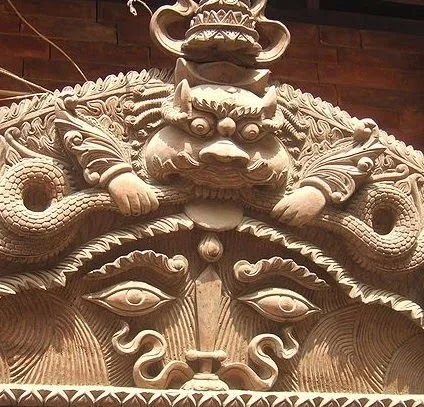
This past week, I told the story of Kirtimukha, and referenced Joseph Campbell’s interpretation of the story - which I said, was kind of bogus. Not to get too critical of Campbell, but he frequently misinterpreted myths so that they would fit into his scholarly concepts like the Monomyth, and by doing that, really diminished their complexity. The story of Kirtimukha, Campbell says, is a story of life feeding on life - this idea that you have to participate in life in order to cross over to the metaphysical realm.
In the story, a demon threatens to steal Shiva’s consort, Parvati. To fight this demon, Shiva opens his third eye, lightning strikes the earth, there is smoke and fire, and a second demon with hair like a lion’s mane appears, with a ravenous hunger, to eat up the first demon. Upon seeing this hungry demon, the first demon throws himself upon Shiva’s mercy, and Shiva grants it. The hungry demon is then very troubled, and asks Shiva what he should do - he was created with a ravenous hunger and has nothing he can do to sate it. Shiva tells the demon to eat himself. And so the demon eats himself, right up to his face. Shiva sees this act of humility, ego obliteration, and succumbing to the wishes of the divine as a worthy act, and names the hungry demon Kirtimukha, or face of glory. For his act of humility and obedience, Kirtimukha’s face is placed over the doors of temples throughout India, and Shiva says that those who will not bow to Kirtimukha are unworthy to bow to Shiva himself.
I don’t know about you, but that seems more complicated than “life feeding on life.” There are things I’m uncomfortable with in this story - submitting to the will of an unknown, unseen god and self-harm are among them. I can also see that it shows how one can make glorious choices in less than ideal circumstances. I can also just listen to the story and enjoy it as a complex but interesting tale. But I’m definitely left with the feeling that Campbell, when trying to lock down this myth’s meaning, made it thinner and less resonant than it started out as.
So as we embark upon this month of story telling, I want to encourage you to try not to tie everything up into a neat package with a clear ending. Enjoy the messiness of these stories. Let yourself live in them and revisit them in ways that allow you to keep thinking and interpreting. Don’t let a simple interpretation beat you over the head and shut down your ability to interpret. Life, our yoga practice, and art is best when it’s a little more mysterious and subtle.
I’ll leave you with a poem that my Grandpa Mosher (my mom’s dad) wrote in 1945. I’m really proud to come from a long line of clever wordsmiths. Enjoy, Galaxy.
ODE TO REQUIRED ENGLISH LITERATURE COURSE
THOMAS M. COOLEY HIGH SCHOOL
DETROIT MICHIGAN

When a poor, well-meaning poet
In an awe-inspiring moment
Created for himself an aimless rhyme-
Did he venture to conjecture
That his verbal architecture
Would leave its mark upon the sands of time?

That a million English teachers
Would examine all its features
And give great portent to its simple thought?
And thus by all this gleaning would obliterate its meaning
But find a million lessons to be taught.

Harry D. Mosher
1945