
February in the Galaxy: Brecht, Singing in the Dark Times, and Nada Yoga
Happy February, Galaxy; we made it out of January. It was rough! It took me 9 days to feel like I had the resources to write this dispatch, and I know many of you are carrying some heavy things these days! I don’t want to write a dispatch that ignores the state of the world, so… I’m not going to ignore it.
Late last year, I chose monthly themes for the entire year all at once, with the help of the Galaxy teaching staff, so this month’s focus of Nada Yoga was chosen long before I could have ever understood the challenges and struggles of January, including the abhorrent actions of ICE in Minneapolis (and in other cities). But when the time came to choose the quote for the studio entryway for this month, I knew exactly what quote I wanted, from my favorite playwright and revolutionary writer, Bertolt Brecht:
“When the times darken,
Will there be singing even then?
Yes, there will be singing even then,
About the dark times.”

I explained this a little on the studio’s Instagram, but this was written by Brecht when he was living in exile from the Nazi regime in Svenborg, Denmark. Brecht’s plays and writing in Weimar Germany were closely intertwined with the Communist party, and its work to resist the Nazi regime. Brecht believed wholeheartedly in art’s power to spur change.
I explained this a little on the studio’s Instagram, but this was written by Brecht when he was living in exile from the Nazi regime in Svenborg, Denmark. Brecht’s plays and writing in Weimar Germany were closely intertwined with the Communist party, and its work to resist the Nazi regime. Brecht believed wholeheartedly in art’s power to spur change. In fact, he also wrote, “Art is not a mirror held up to reality, but a hammer with which to shape it.” Brecht wrote in order to explore ideas that would hopefully change the world order, and relied on the power of performance and song to convey those ideas to audiences.
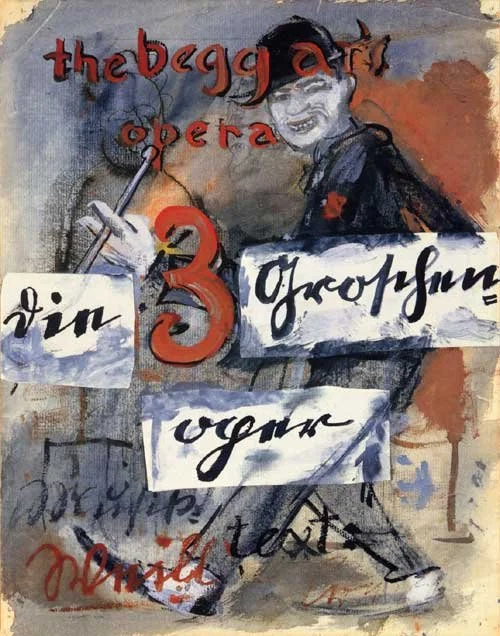
I think that’s why a work like “Die Dreigroschenoper” aka “The Threepenny Opera” is still so arresting and riveting today, and was outright banned by the Nazi Regime as “degenerate art.” Brecht and his collaborators (Elizabeth Hauptmann’s original adaptation and of course, Kurt Weill’s stunning music) were wrestling with how those who are given little in life might resort to terrible means in order to keep living, while those who hoard resources, money, and power will eventually experience a reckoning of revolution.
And maybe it doesn’t really resonate you’re reading my interpretation of it, but when you watch someone perform (or even just hear audio) of someone singing “What Keeps Mankind Alive?” You feel the injustice to your bones:
You gentlemen who think you have a mission
To purge us of the seven deadly sins
Should first sort out the basic food position
Then start your preaching, that’s where it begins
You lot who preach restraint and watch your waist as well
Should learn, for once, the way the world is run
However much you twist or whatever lies that you tell
Food is the first thing, morals follow on
So first make sure that those who are now starving
Get proper helpings when we all start carving
What keeps mankind alive?
What keeps mankind alive?
The fact that millions are daily tortured
Stifled, punished, silenced and oppressed
Mankind can keep alive thanks to its brilliance
In keeping its humanity repressed
And for once you must try not to shrink the facts
Mankind is kept alive by bestial acts.
And wow, I didn’t really mean to write about Brecht this much, but damn, do I ever love Brecht and Weill. Here’s some audio of Tom Waits singing this song, with the Kronos Quartet:
So, you know that feeling when a song, or a poem, or a piece of music pierces that veil of complacency that we can sometimes get caught in?
I think that’s the essence of Nada Yoga.
Nada Yoga is the yoga of sound - which could be music, or could be a powerfully spoken word, a well-crafted poem, or could be something as short, sweet, and elegant as a tone or what we call a bija mantra, or a seed sound. It’s a practice that acknowledges the power of the sound wave. When we’re intentional about how we use things like our words, our music, and our attention to what we are hearing - we can invoke incredible shifts in our consciousness. And I think it’s often the basis for shifts in global consciousness.
I can’t explain exactly how, but when I hear those words in “What Keeps Mankind Alive” sung to me, I understand the injustice of people who can’t meet their basic needs being moralized to. I understand it in a way that makes me want to change it immediately.
I can’t explain why, watching Bad Bunny last night on the Superbowl, I felt like there was a tiny little shred of hope still present for our country, if we could keep on elevating these music makers and the people, land, art, and culture that they represent. You can watch it here, if you somehow missed it, or want to watch it again for the 100th time ;)
I’ve always marveled at the ways that song, poetry, and art accompany social revolutions - from the songs of the Underground Railroad, to the gospel singers like Mahalia Jackson who were a part of the Civil Rights movement, to Brazilian Tropicalia music, to singing at Minnesota protest last week, linked here.
If we sang a little louder, listened to the right things with the right set of ears, and spoke like our lives depended on it - how might things change? I think this is all the practice of Nada Yoga.
So while Nada Yoga in the studio might be chanting the component sounds of OM, or singing a mantra together - maybe this month, you keep your eyes, ears and hearts open to see the power of the sound wave in action, and join in and sing along, if the spirit moves you.
“Yes, there will be singing even then, about the dark times…”
xo,
a