
April in the Galaxy: Am I a falcon, a storm, or a great song?
Don O'Hagan, best English teacher ever, the power of the Great Song, and music with lyrics in a yoga class…
Happy April, Galaxy! I’ve been procrastinating on this Dispatch, because I was having trouble circling in on exactly what I wanted to write about. I think it’s partly because we kind of “went big” on this month’s theme - it’s BOTH poetry AND the Bhagavad Gita, and while they’re related, they’re also quite substantial stand-alone themes. But as I always say: why choose something simple when you could choose something complicated? (Is the sarcasm coming through?)
The Bhagavad Gita is probably THE most important spiritual text of Hindu literature. I would say that it’s polarizing - there are aspects of it that are very difficult to grapple with, especially as it concerns one’s place in life (you were placed where you are by God, and your responsibility is to “stay in your lane”), how much control you have over your life (you basically need to surrender your will to God’s will), and what right you have to lay claim to the fruits of your actions (no right whatsoever). That’s an oversimplification, obviously, but if you’ve ever struggled with reading the Gita, know that you’re not alone.

The Gita is a part of a larger epic poem called the Mahabharata, which also includes the Ramayana; the story of Sita, Ram, Hanuman, and the demon Ravana.
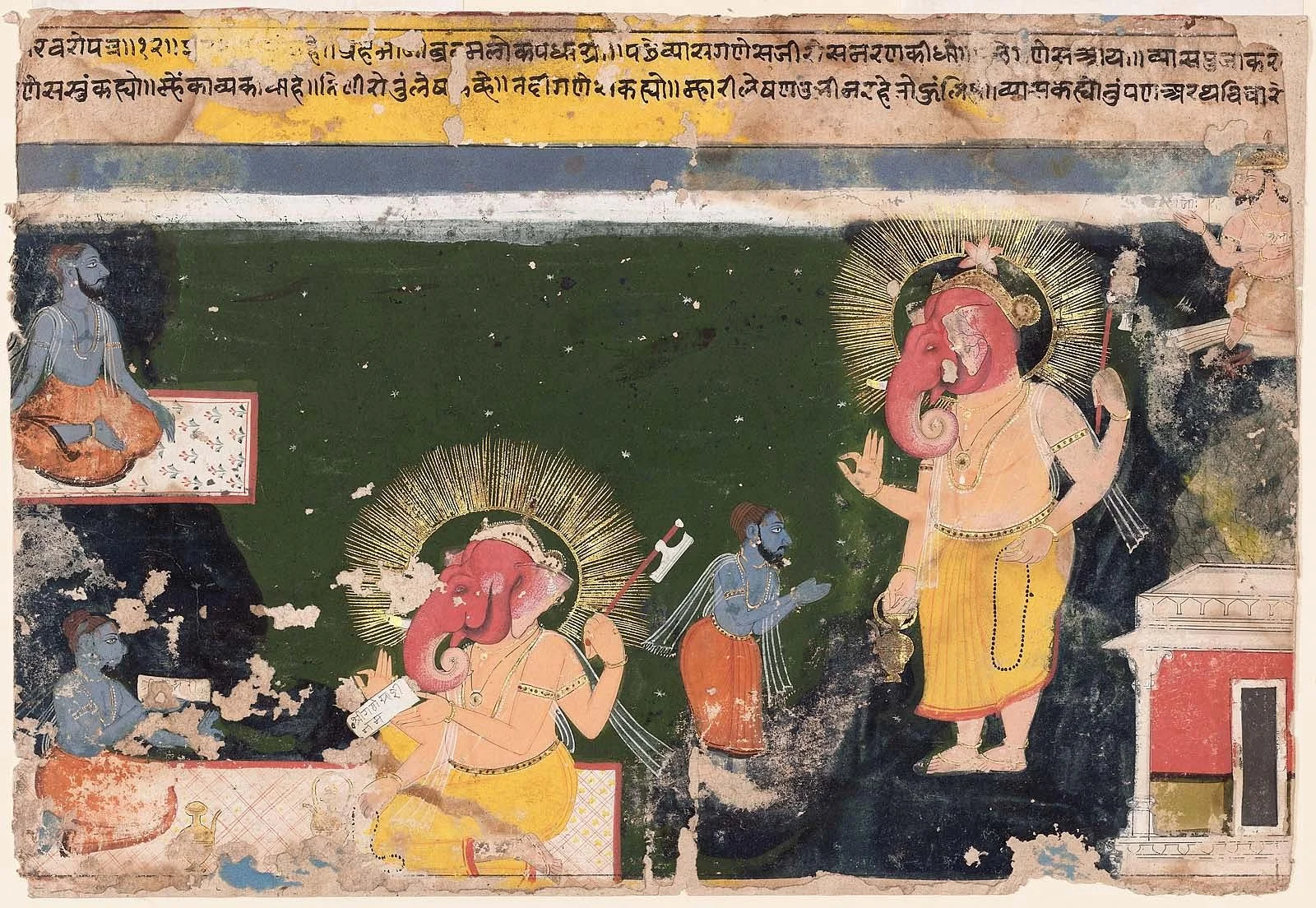
All of these works are considered to be of the body of texts referred to as smriti - or that which is remembered. Smriti is characterized by attribution to a particular/specific author, and transmitted through manuscripts. This designation is in contrast to sruti, or that which is heard, which is not as often ascribed to a specific author, and which is transmitted from teacher to student orally. The text of the Gita and the larger Mahabharata is also a part of the kavya tradition, which was a written style popularized by Indian court poets from as far back as 200 BCE through 1200CE, and utilized literary figures of speech like simile and metaphor, to emotional effect.
As I was researching this, it seemed to point me again and again toward the power and place of the written and spoken word. Poetry as an art form will often ask you to read and sit with small nuggets of words and phrases, read and speak them over and over again, to unlock further meaning and feeling the more you experience the words, via your eyes or your ears, or both. But the Gita is more than just powerful poetry - Bhagavad Gita translates as the Song of God, or the Divine Song. So the Gita isn’t just an epic poem - it’s a song, that hopefully pairs both the richness of poetic verse with the emotional power of music. That’s why I’ll be chanting lots of Gita verses this month for you in my classes.
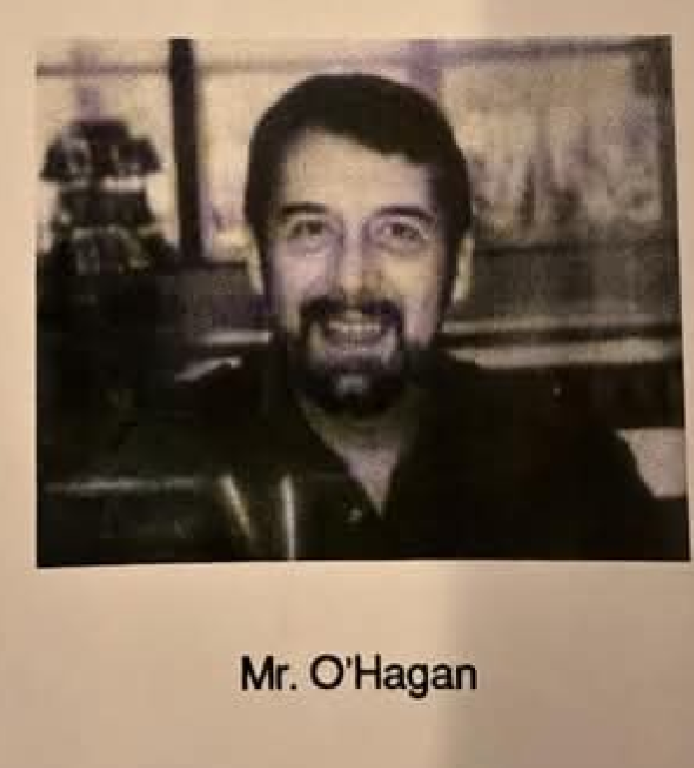
And all this brought me back to my favorite English teacher of all time: Don O’Hagan. I was able to hunt down a screenshot of a picture of him from my senior yearbook, but there’s another pic I remember of him as a young teacher, with a cool beard and longer hair and this rad leather bracelet, so just picture that, too. Mr. O’Hagan was an unrepentant smoker, and was about as “out” as one could be when I knew him in the 90s, openly living with his life partner - quite a role model and icon for my friends who were LBGTQ (back when we really didn’t have these words so easily a part of our vocabulary).
Mr. O’Hagan seemed to recognize in me a love for deep interpretation of literature before I even realized it myself. I knew I loved to read, but I knew nothing about reading closely into a text, how to analyze, or what to look for. After somehow mysteriously receiving his blessing to take AP Literature a year ahead of time, I dove headfirst into All Things Literary with him, and was given the gift of reading epic poems like Beowulf, and Sir Gawain and the Green Knight. I learned to pronounce Middle English and memorized a passage from the Canterbury Tales, to read aloud in front of my fellow AP Lit buddies. We read the verse play JB by Archibald MacLeish, all about the trials of Job, which Mr. O’Hagan actually directed at Dearborn High School, early in his teaching career. We read the Bible as a literary work (with lots of time spent on Song of Solomon, of course), John Donne in both his Jake the Rake early career and as the spiritual poet he evolved into, and I also had an incredible independent study semester reading Shakespeare plays and sonnets with him, one on one. Reading the Tempest with Mr. O’Hagan is a core memory, and I still get the chills and teary when I read excerpts from it.
And one of my most favorite assignments that he gave was to bring in a song, and analyze the lyrics as a poetic work. OBVIOUSLY, I brought in a Tori Amos Song (China, from “Little Earthquakes”). It was an eye-opening moment for me, because it helped me to see that poetry exists in lots of unexpected places, if we both listen and read it rightly. There’s no reason to create a hierarchy of better and lesser poetic works, and like the tradition of the Bhagavad Gita, and other kavya works, these literary devices come together to MOVE us, to make us feel, and understand in layers that we might miss if we took it in as a more one-dimensional piece of writing.
Which makes me think about playing music in yoga class. I know that playing music that has no words is often held up as a “best practice” by many people who train and mentor yoga teachers. I don’t think I’ll ever agree with that as a best practice. I’ve had too many moments in class where a song, with impeccable lyrics and just the right chords, combines with my experience of uniting the breath, the movement, and the attention, and creates the same feeling as a close literary read - an uncovering, a deeper understanding of myself, through the framework, art, and craft of the song, and I’m forever changed.
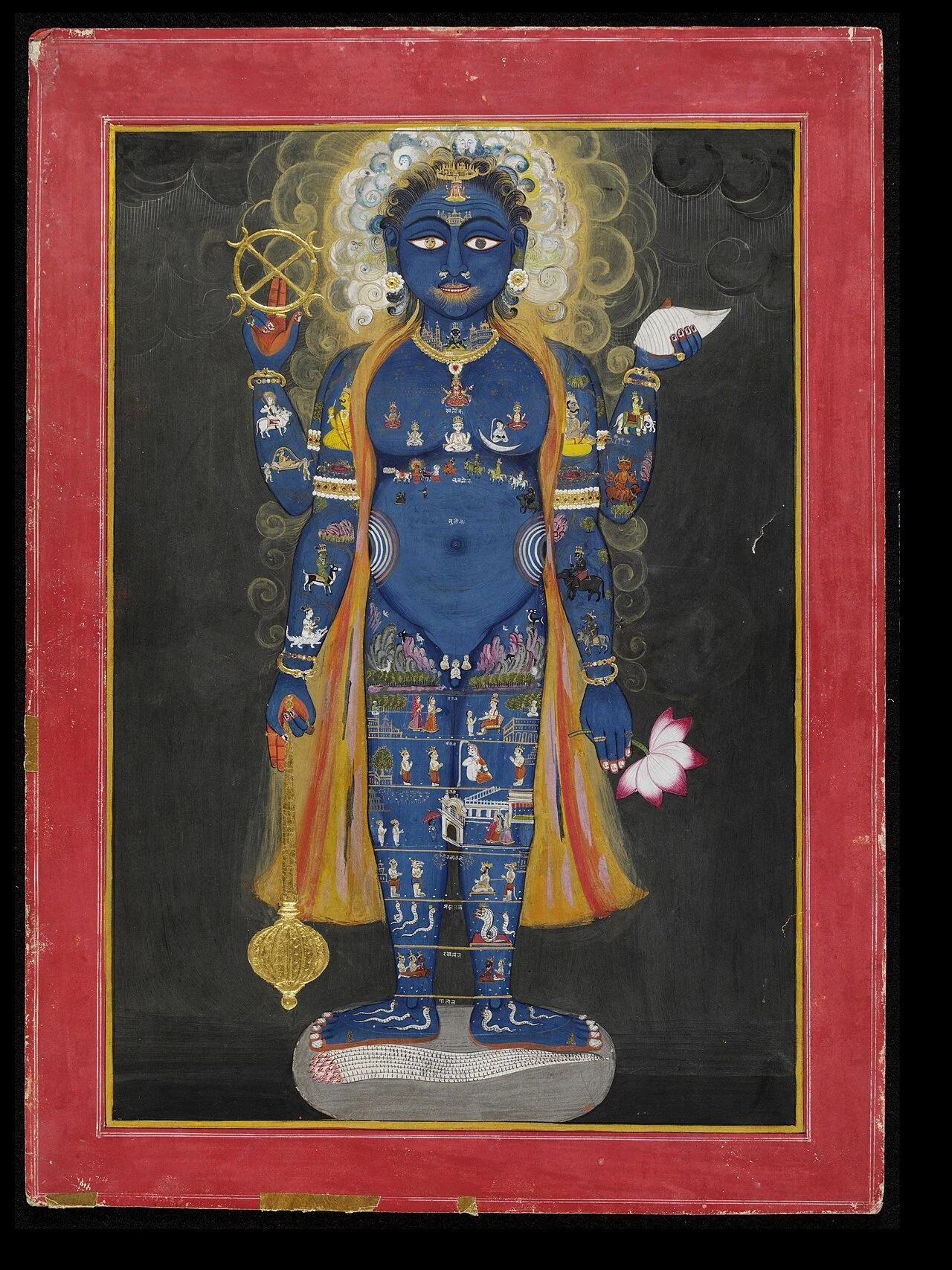
It’s kind of like in the Gita, when Arjuna is speaking with Krishna on the battlefield, and he asks Krishna to reveal himself in all the splendor of his ultimate form. Krishna is like, lol okay you asked for it, and reveals himself, as he truly is - this avatar is sometimes called Vishvarupa, and this is one of many fabulous depictions of him. The following verses are perhaps my favorite from the Gita, and it’s the closest I can get to explaining how I feel in those moments where the music, the lyrics and the practice combine in that magical way.
“After he had spoken these words,
Krishna, the great Lord of Yoga,
Revealed to Arjuna his majestic,
Transcendent, limitless form.
With innumerable mouths and eyes,
Faces to marvelous to stare at,
Dazzling ornaments, innumerable
Weapons uplifted, flaming—
Crowned with fire, wrapped
In pure light, with celestial fragrance,
He stood forth as the infinite
God, composed of all wonders.
If a thousand suns were to rise
And stand in the noon sky, blazing
Such brilliance would be like the fierce
Brilliance of that mighty Self.
Arjuna saw the whole universe
Enfolded, with its countless billions
Of life-forms, gathered together
In the body of the God of gods.
Trembling with awe, his blood chilled,
The hair standing up on his flesh,
He bowed…”
[Gita 11.9-11-14]
Mic drop, Galaxy. This is why I will always praise the power of the song, the poetry of the lyrics, and why music with words will always be a part of my yoga classes. Life isn’t just the Poetry of God - it’s the Song of God. Why would you deprive yourself of the opportunity to experience that?
As the great Rilke asks: “Am I a falcon, a storm, or a Great Song?”
I sure as hell know which one of those options I would like to be.
Xo,
a